

Have you ever cranked up the bass in your car, only to hear that a disappointing, flabby thump instead of a rich, soul-shaking rumble? It’s a common frustration, and if you’ve been there, you’ve probably come to a powerful realization: your factory-fitted stereo just isn’t going to cut it. You can have the most expensive, most powerful subwoofer in the world, but without the right amplifier to drive it, it’s like having a Ferrari engine in a go-kart. The right amp is the heart and soul of your car’s audio system, the unsung hero that takes a tiny signal and turns it into a thunderous sound that you can not only hear but feel.
Why Does Your Subwoofer Need Its Own Amplifier?
This is the fundamental question, and the answer is surprisingly simple. Your car’s head unitthat’s your stereo, the part you interact withis built to handle the small power requirements of your car’s main speakers, the ones for mids and highs. But subwoofers? They’re power hogs. They require a significant amount of electrical energy to move air and create those low-frequency vibrations we call bass.
Trying to run a subwoofer off your head unit’s built-in amplifier is like trying to power a skyscraper with a AA battery. It just doesn’t work. The head unit will quickly become overworked, leading to distorted sound and, in the worst-case scenario, damage to your equipment. A dedicated external amplifier provides the clean, consistent, and powerful signal that a subwoofer needs to perform at its best. It’s the difference between a feeble whisper and a powerful roar, ensuring your bass is tight, punchy, and clear, not just loud and distorted.
The Golden Rule: Matching RMS Power
If you take only one thing away from this article, let it be this: match the RMS power. This is the single most important factor when choosing an amplifier for your subwoofer. RMS stands for “Root Mean Square,” and in simple terms, it represents the continuous, real-world power that a piece of equipment can handle without being damaged.
When you look at a subwoofer’s specifications, you’ll see two power ratings: RMS and Peak Power. Peak power is the maximum power the sub can handle in a fleeting moment, like a sudden drum kick. It’s a marketing number and largely irrelevant for matching purposes. RMS, however, is the number you care about. It tells you the power the subwoofer can handle continuously, all day long.
The golden rule is this: your amplifier’s RMS power output at the subwoofer’s impedance should be roughly equal to the subwoofer’s RMS power rating. A good rule of thumb is to aim for an amp that provides somewhere between 75% and 125% of your sub’s RMS rating. For example, if your subwoofer is rated at 500 watts RMS, you should look for an amplifier that can deliver between 375 and 625 watts RMS. This gives you a bit of headroom without overpowering the sub and risking damage.
The Crucial Concept of Ohms: Impedance Matching
Now for the next big piece of the puzzle: ohms. This is where many people get tripped up, but it’s actually a straightforward concept.
What Exactly is Impedance?
Think of electrical current like water flowing through a pipe. The power from your amplifier is the water pressure. The subwoofer’s impedance, measured in ohms (Ω), is the resistance to that flow. The lower the ohm rating, the less resistance there is, and the more current the amplifier can send to the subwoofer.
Subwoofers come in various impedance ratings, most commonly 2 Ohms, 4 Ohms, or dual voice coil configurations (e.g., dual 4 Ohm). The important thing to know is that your amplifier’s power output changes depending on the load (the subwoofer’s impedance) it’s driving.
The Right Ohms for the Job
This is where you need to be careful. An amplifier that is rated at 500 watts RMS at 4 Ohms might only be rated at 300 watts RMS at 2 Ohms. Okay, maybe I have that backwards, an amp will typically have a higher output at a lower impedance. It’s crucial to check your amplifier’s specs to see its power output at different ohm loads. For example, an amp might advertise “800W max,” but the fine print says “400W RMS at 4 Ohms and 800W RMS at 2 Ohms.” If you have a 500W RMS subwoofer, you need to make sure the amp you choose can deliver close to that power at the specific ohm rating of your subwoofer.
For dual voice coil subwoofers, you have wiring options. You can wire a dual 4 Ohm sub in series for an 8 Ohm load, or in parallel for a 2 Ohm load. You need to know how you plan to wire your sub to find an amplifier that’s optimized for that specific ohm load. It’s a classic case of getting the right tool for the job.
Mono or Multi-Channel? Understanding Amplifier Types
When it comes to amplifiers for subwoofers, you have a few options.
Mono-channel Amplifier (or Mono Block):
This is the most common and often the best choice for a dedicated subwoofer amplifier. A mono amp is designed to drive a single subwoofer (or multiple subwoofers wired together) with one dedicated channel. They are typically optimized to be highly efficient and deliver lots of power at low impedance loads (2 or even 1 Ohm), which is exactly what a subwoofer needs.
Multi-channel Amplifier:
You might already have a 4-channel amplifier to power your car’s main speakers. In this case, you can often “bridge” two channels together to create a single, more powerful channel to run your subwoofer. For instance, a 4-channel amp rated at 100 watts per channel might be able to be bridged to deliver 200 watts into a single channel. While this can work, a mono amp is usually a better choice for high-power subwoofer setups, as it’s designed from the ground up to do one thing and do it extremely well.
Decoding Amplifier Classes: Class D is Your Friend
Amplifiers come in different “classes,” which describe their electronic design and efficiency. For subwoofers, there’s one class you should almost always choose:
Class D:
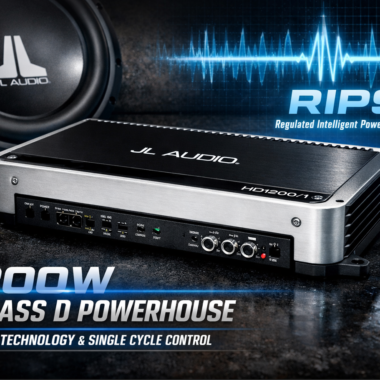
This is the most efficient type of amplifier, often operating at 80-90% efficiency. This means they convert most of the power they draw into audio output, with very little being wasted as heat. This makes them smaller, lighter, and much more suitable for a subwoofer in a car. They generate less heat, which means they can be tucked away in tight spaces, and they put less strain on your car’s electrical system. For subwoofers, which operate at low frequencies and draw a lot of power, a Class D amp is the ultimate workhorse.
Class AB:
While still a popular choice for full-range speakers (mids and highs), Class AB amps are less efficient (around 50-60%) and generate a lot more heat. They’re not the best choice for a dedicated subwoofer amp, especially in a compact installation, as they can overheat and go into protect mode.
Essential Features to Look For on Your Amp
Besides the power ratings and class, a good subwoofer amp will have a few key features that give you fine-tuned control over your bass.
Gain Control: More Than Just Volume
Gain control is probably the most misunderstood feature on an amplifier. Many people mistake it for a volume knob, but it’s not. The gain knob sets the amplifier’s input sensitivity, allowing it to match the output voltage of your head unit. Think of it as a gatekeeper. If your head unit sends a strong signal, you need a lower gain setting. If it’s a weak signal, you turn the gain up. Setting the gain correctly is crucial to prevent distortion, or what’s commonly known as “clipping,” which can quickly destroy your subwoofer.
The Low-Pass Filter (LPF): Keeping It Clean
This is a non-negotiable feature for a subwoofer amp. A low-pass filter (LPF) is an electronic filter that only allows frequencies below a certain point to pass through to the subwoofer. It’s your secret weapon for ensuring your subwoofer only plays the bass notes and nothing else. You typically want to set your LPF to a frequency between 80 Hz and 100 Hz. This ensures that the subwoofer is only producing the deep, low-frequency tones it was designed for, while your main speakers handle the mids and highs. It’s this kind of filter that separates a clean, musical bass system from a messy, muddy one.
Putting It All Together: A Step-by-Step Guide
Let’s recap the process in a simple, actionable way:
- Check Your Subwoofer’s RMS Rating: Find the continuous RMS power rating of your subwoofer. Don’t worry about the peak power number.
- Determine the Impedance: Find out the ohm rating of your subwoofer (e.g., 2 Ohm, 4 Ohm). If it’s a dual voice coil sub, decide how you’ll wire it to get the final impedance you need.
- Choose a Mono Block Amp: For most subwoofers, a dedicated mono-channel amplifier is the best choice.
- Match the Power & Impedance: Find a Class D mono amp whose RMS power output at your subwoofer’s impedance is a close match (within 75-125%) to your subwoofer’s RMS rating.
- Look for Key Features: Make sure the amp has a low-pass filter and a gain control.
- Don’t Forget the Wiring: Purchase a quality, correctly gauged wiring kit.